

The Costa da Morte by motorhome
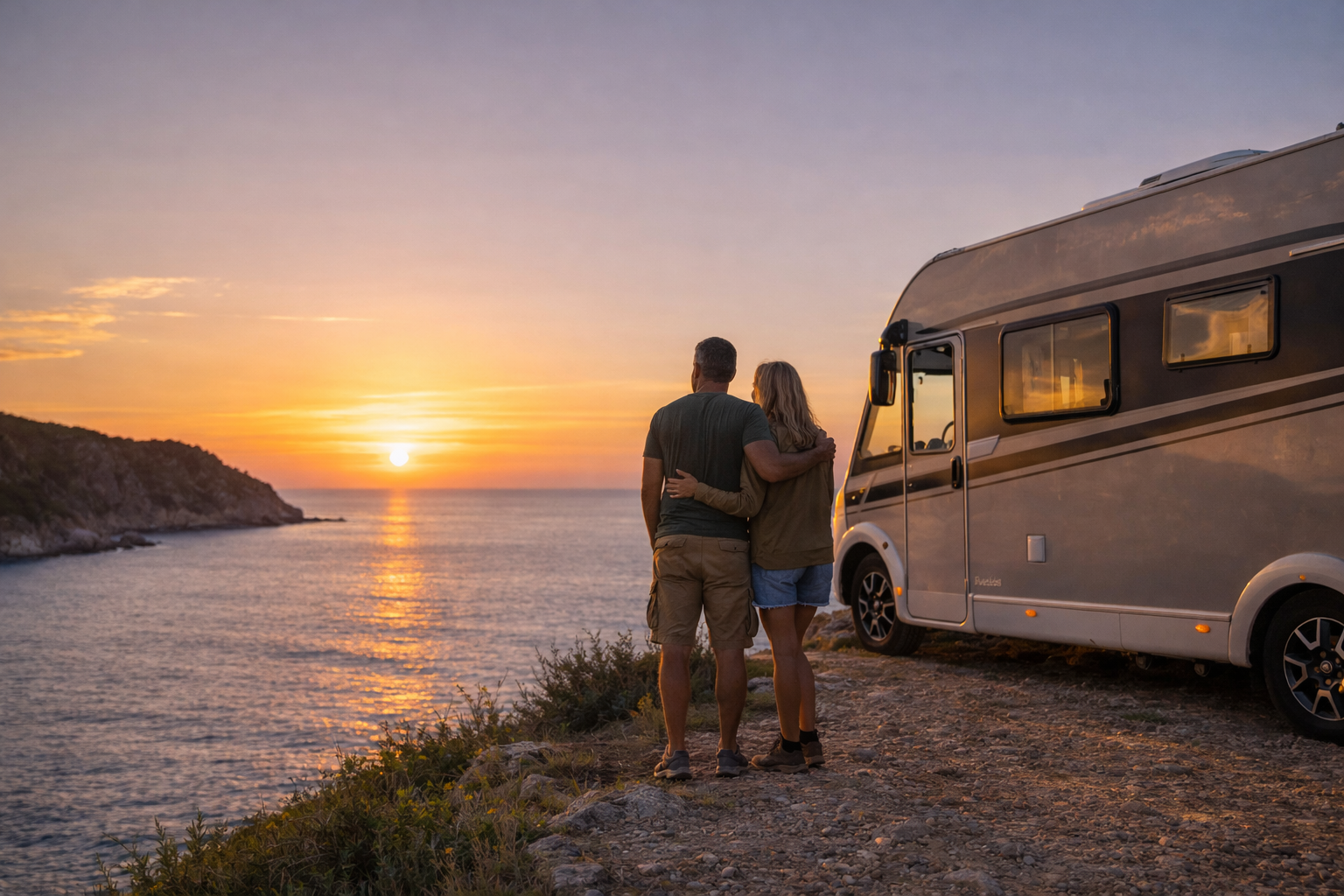
Lighthouses on top of cliffs, fishing villages that live off goose barnacles and octopus, huge beaches that are almost empty and sunsets at the place the Romans believed was the end of the world. The Costa da Morte is Galicia at its wildest and one of the most beautiful routes you can drive by motorhome.
You set off from A Coruña, head down the Atlantic coast from lighthouse to lighthouse as far as Fisterra and finish at the Ézaro waterfall and Carnota beach. The stages are short, so with six days you can travel at a relaxed pace and have time for walks.
Day-by-day itinerary
A Coruña → Malpica → Laxe → Camariñas → Muxía → Fisterra → Ézaro → Carnota
Route and campsite map
Hover over a stop, a campsite or any other route to see more information. Zoom out to see all our routes across Spain.
Day 1. A Coruña → Malpica
about 60 km
Start at the Tower of Hercules, the only surviving Roman lighthouse and the oldest working lighthouse in the world. Stroll through the park around it, by the sea, with views along the whole coast. The city council has a few signposted car parks for motorhomes, one of them near the tower, intended for daytime visits.
In the afternoon head for Malpica, a fishing village with a harbour full of boats and a town beach right next to the village. Drive out to Cabo San Adrián, about 4 km away, to see the Sisargas Islands just offshore from the chapel.
Day 2. Malpica → Corme → Laxe
about 50 km
On the way, stop at the Dolmen de Dombate, a megalithic monument just a few metres from the road. Then take a detour to Corme and Punta do Roncudo, where crosses remember the barnacle fishermen who lost their lives on these rocks.
End the day in Laxe, with a white sandy beach more than a kilometre long and calm water. Walk up to the lighthouse, next to the sculpture A espera, dedicated to the families of sailors, and follow the headland to the little Praia dos Cristais, covered in glass polished by the sea.
Day 3. Laxe → Camelle → Camariñas and Cabo Vilán
about 45 km
Pass through Camelle, a tiny harbour among granite rocks, and carry on to Camariñas, the village of bobbin lace. At the Museo do Encaixe you discover the history of this craft, which is still very much alive in the village.
At sunset drive up to Cabo Vilán on the paved road. Its lighthouse, from the late 19th century, was one of the first in Spain to use electric light, and the view of the cliffs is stunning. The Cemiterio dos Ingleses, which remembers the wreck of the ship Serpent, is reached on a dirt track: don't take the motorhome, go on foot or by bike.
Day 4. Camariñas → Muxía and Cabo Touriñán
about 60 km
Drive round the estuary to Muxía. By the sea stands the Virxe da Barca sanctuary, with the Abalar and Cadrís stones, and close by the sculpture A Ferida, which recalls the Prestige disaster. Climb Monte Corpiño to see the village from above and look out for the conger eel drying racks at the harbour.
In the afternoon head out to Cabo Touriñán, the westernmost point of mainland Spain. The road is narrow but in good condition, and the sunset there is usually much quieter than in Fisterra.
Day 5. Muxía → Fisterra
about 45 km
Pass through Cee and Corcubión, two seafaring towns at the head of the estuary. In Fisterra go down to the harbour, eat some fish and have a swim on the long Praia da Langosteira.
The lighthouse is about 3 km from the town and is the end of the road for many pilgrims. If you go at sunset in summer, get there early or walk up, because the car park fills up. And at night go back to the motorhome area or the campsite: sleeping at the cape is not a good idea.
Day 6. Fisterra → Ézaro → Carnota
about 35 km
At Ézaro the river Xallas reaches the sea as a waterfall, something almost unique in Europe. A wooden boardwalk takes you to the foot of the falls. The flow depends on the hydroelectric plant, and on some summer nights the waterfall is lit up; check the calendar.
Carry on to Carnota, with the longest beach in Galicia, about 7 km of sand and dunes at the foot of Monte Pindo. In the village don't miss the Hórreo de Carnota, about 35 metres long and from the 18th century, one of the longest granaries in Galicia.
Day 7. Back to A Coruña or Vigo
about 110 km to A Coruña or about 150 km to Vigo
Head back inland via Santiago de Compostela, which is almost on the way, or go down through Muros and the Rías Baixas coast if you are returning the motorhome in Vigo.
Where to stay on the route
On the Costa da Morte there are free municipal motorhome areas and a few private areas and campsites, but there are not many pitches and in July and August they fill up. More and more Galician councils are cracking down on overnight stays at beaches, capes and viewpoints, so the most relaxed option is always to sleep at motorhome areas or campsites.
Campsites and motorhome areas along the way
- Muxía: free municipal motorhome area at the entrance to the village, by the AC-440, with water and waste disposal. It has few pitches and a maximum stay of 48 hours.
- Muxía: Camping Lago Mar, in Merexo, above Praia do Lago, open from spring to September.
- Fisterra: private motorhome area next to Praia da Langosteira, a few minutes' walk from the centre, with services and a maximum stay of 72 hours. In summer call ahead.
- Carnota: paid motorhome area next to the Lariño lighthouse, with about ten pitches; reception is at the lighthouse bar.
Tips for this route
- Don't drive the motorhome up to the Ézaro viewpoint: the road is extremely steep and not suitable for large vehicles. Go on foot or by car.
- Avoid dirt tracks, such as the one to the Cemiterio dos Ingleses. The roads between villages are narrow and winding, so drive calmly.
- The wind on the capes can be very strong: don't open the awning and park facing into the wind.
- Bring warm clothes and a rain jacket even in summer: the weather on the Atlantic coast changes quickly.
- Fill up with water and empty your tanks at motorhome areas with services: there are few service points on the coast.
- Parking is not camping: outside campsites and motorhome areas, don't put out your awning, chairs or tables.
Frequently asked questions
How many days do I need for the Costa da Morte by motorhome?
With five or six days you can drive from A Coruña to Carnota without rushing. If you have a week, add Santiago de Compostela or an extra beach day in Carnota.
Can I sleep anywhere on the Costa da Morte?
Parking is allowed wherever it is not prohibited, but many councils keep an eye on overnight stays at capes, beaches and viewpoints. The safest option is to sleep at motorhome areas and campsites and check the current rules in each village.
Can I drive to the Fisterra lighthouse in a motorhome?
Yes, the road to the lighthouse is paved and there is a car park, but in summer and at sunset it fills up. Go early or walk up from the town, about 3 km.
When is the best time for this route?
From May to October you get long days and mild temperatures. June and September are ideal: fewer people than in August and more free pitches at the motorhome areas.
Motorhomes for this route
Pick up your motorhome in A Coruña and start the route the same day, or set off from Vigo.

- Husbil
- Galicia (A Coruña)
- 4 personer

- Husbil
- Galicia (A Coruña)
- 6 personer

- Husbil
- Galicia (Vigo)
- 4 personer
Fancy doing this route?
Pick up your motorhome in A Coruña or Vigo and discover the Costa da Morte from lighthouse to lighthouse.
See available motorhomesMessage us on WhatsApp